
Service Design
Complaints & Notifiable Incidents
Designing clearer reporting, intake and triage across regulatory services
A cross-modal service-design initiative to make complaints and notifiable incident reporting clearer for customers and duty holders while creating more structured intake, triage and operational visibility.
Selected project evidence
The work behind the outcome.
Research, journeys, prototypes and delivered outputs selected to show how the project moved from evidence to decision and delivery.
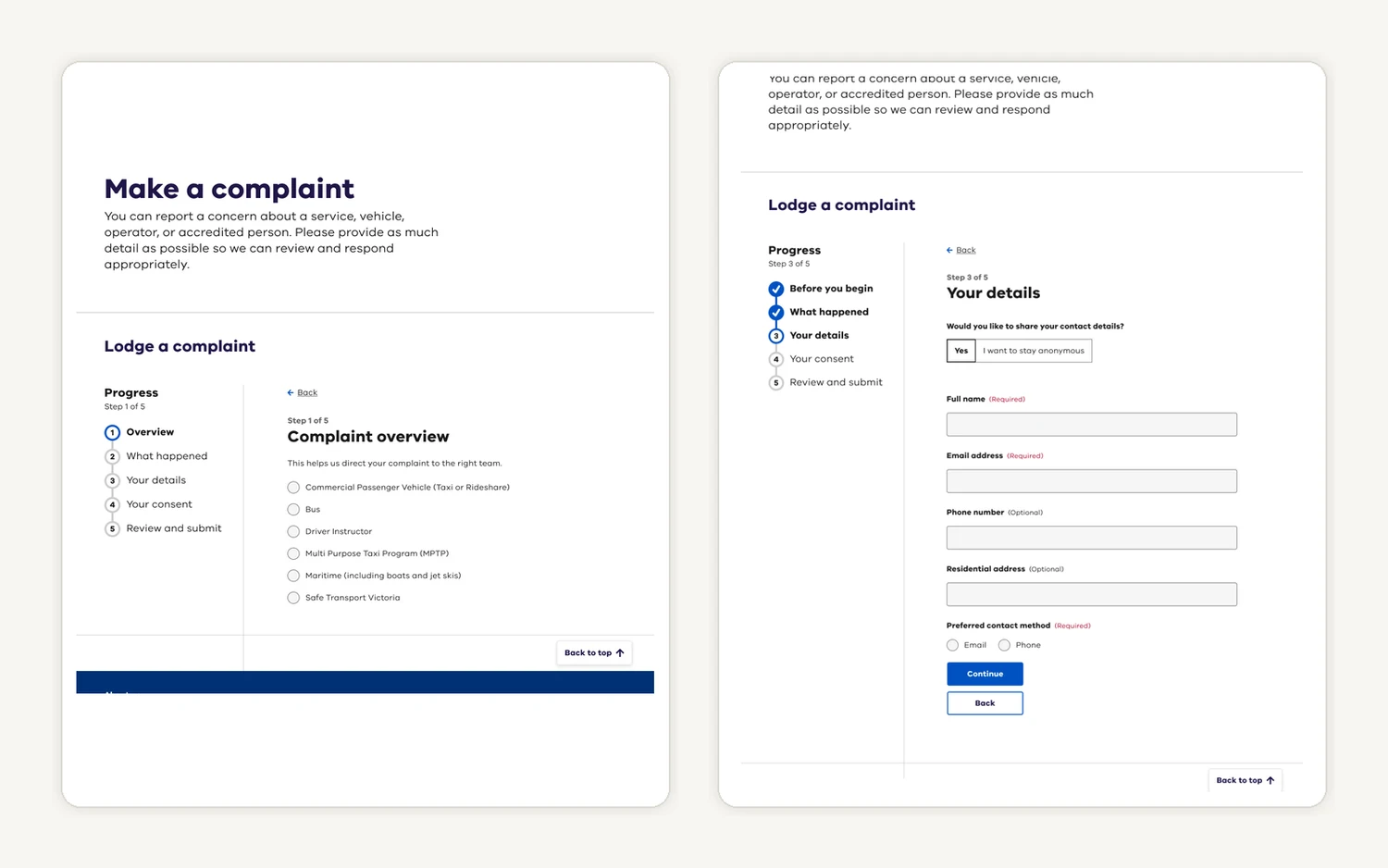
The complaint flow uses a clear entry point, progressive steps and structured questions so the matter can be directed to the right team with useful information.
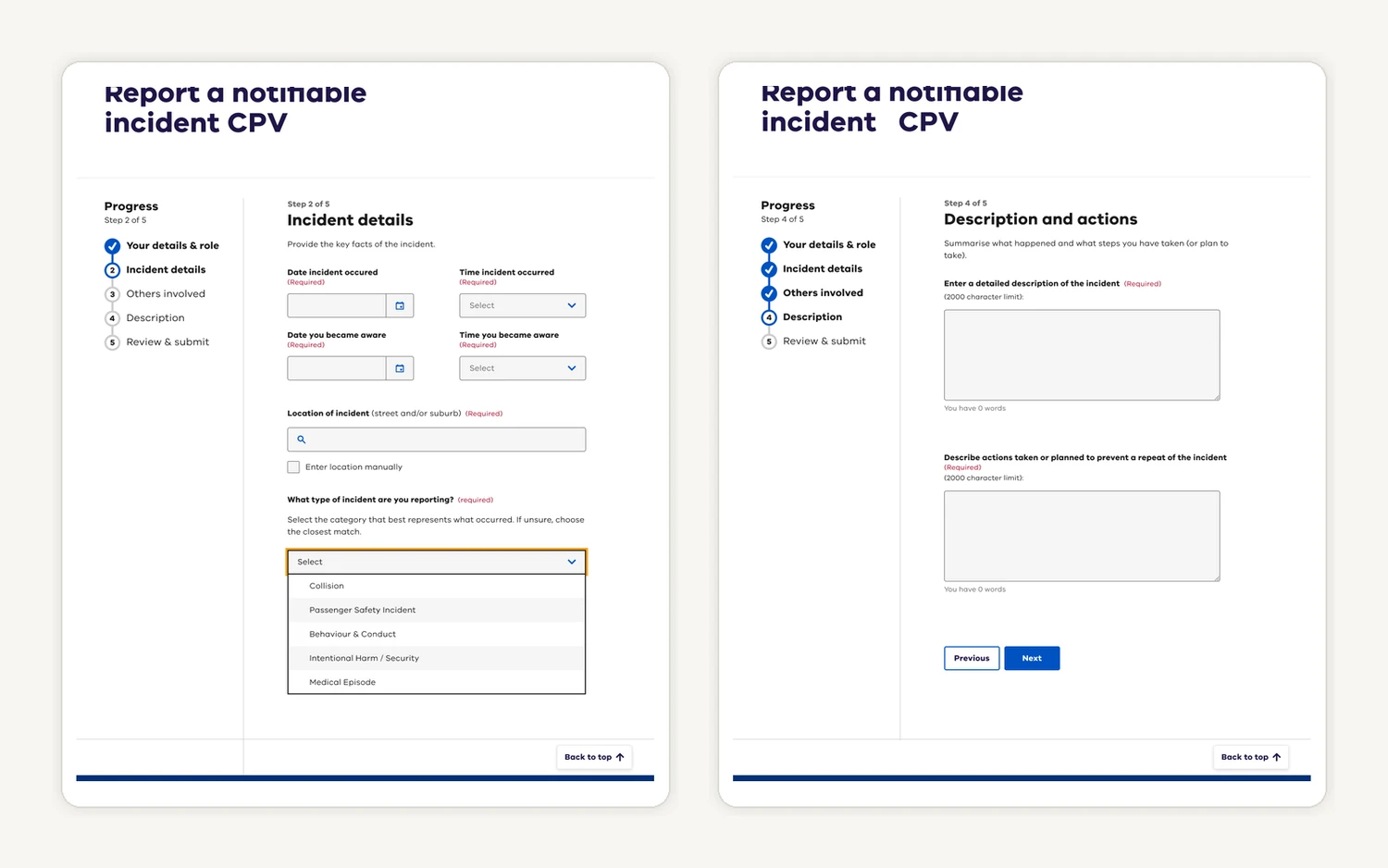
The notifiable incident flow captures incident facts, parties and actions in a structured sequence designed around regulatory triage and follow-up.
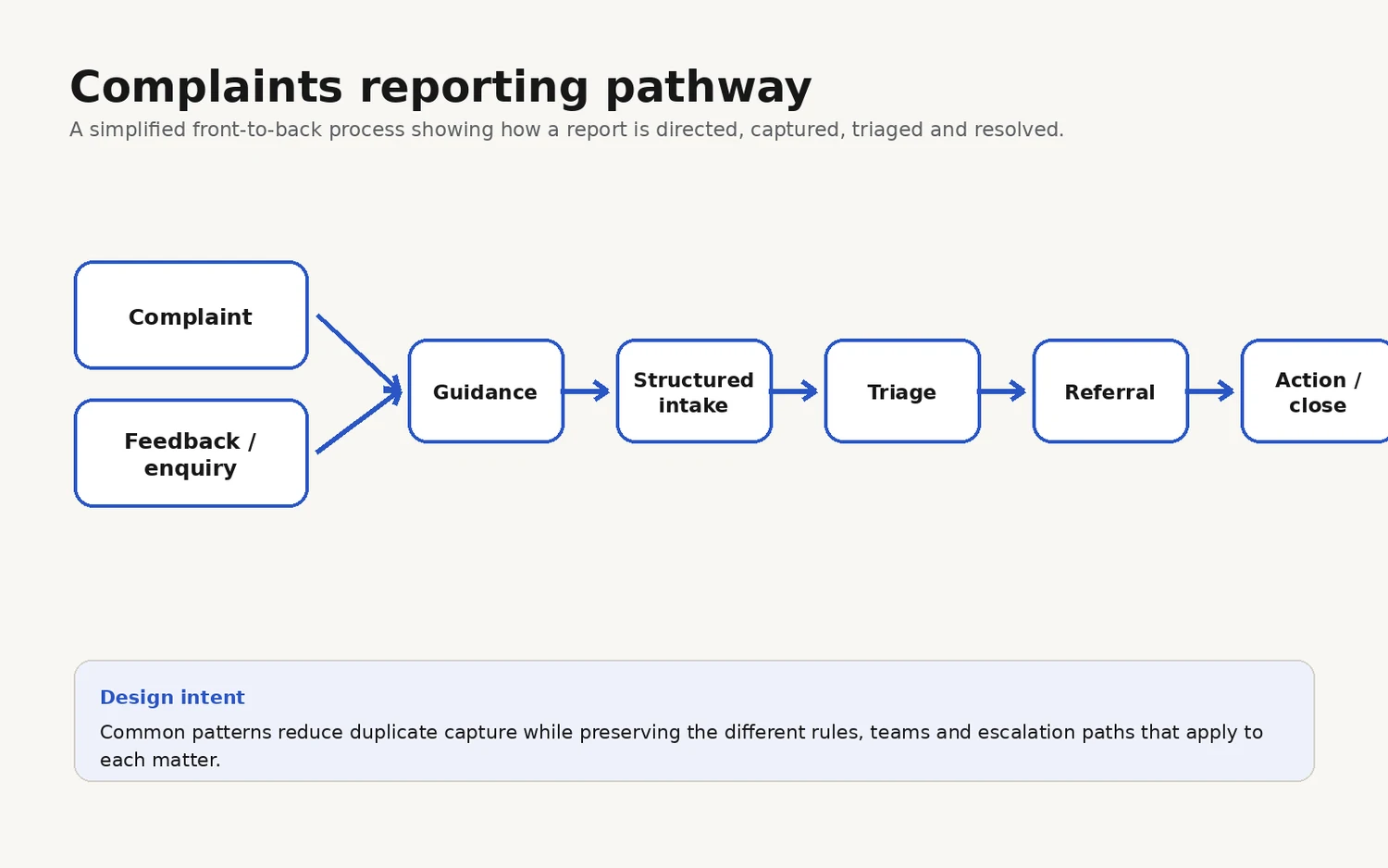
A simplified service process shows how guidance, structured intake, triage, referral and resolution work together behind the customer-facing form.
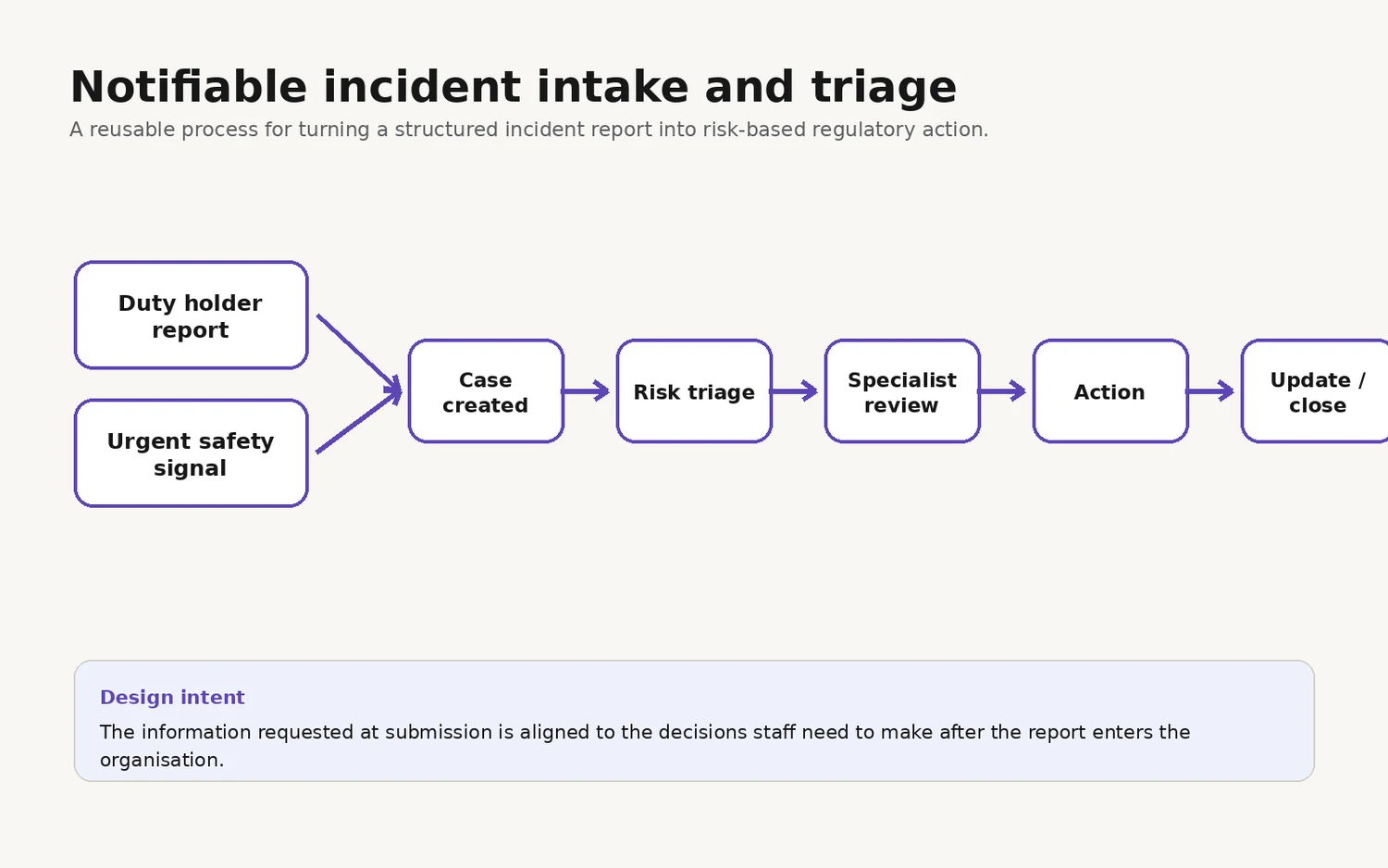
The backstage process links structured incident data to case creation, risk assessment, specialist review, regulatory action and reporter updates.
The opportunity
A cross-modal service-design initiative to make complaints and notifiable incident reporting clearer for customers and duty holders while creating more structured intake, triage and operational visibility.
My contribution
I led discovery and service mapping across reporting pathways, aligned customer-facing forms with regulatory obligations and designed a reusable Salesforce-enabled intake and triage model.
Public portfolio version. Sensitive architecture, security, commercial and operational detail has been intentionally omitted.
Context and challenge
Complaints and notifiable incidents are both ways people report concerns to a regulator, but they serve different purposes and can trigger very different regulatory responses.
Across commercial passenger vehicles, bus and maritime services, reporting pathways had evolved differently. Guidance was often high level, forms and data requirements varied, and the distinction between a complaint, a notifiable incident and another type of enquiry was not always obvious to the person reporting.
Behind the scenes, information could arrive through web forms, email, PDF, spreadsheets or other channels. Staff then had to interpret the report, record it, triage risk, refer it to the right team and maintain visibility of what happened next.
The strategic challenge was to simplify the front door without pretending the underlying legislation and operating models were the same.
My role
I led the service-design work across customer-facing reporting and the operational process behind it.
- Mapped complaint and incident reporting pathways across CPV, bus and maritime contexts.
- Worked with regulatory, safety, complaints, customer-service and technology stakeholders to understand legal and operational differences.
- Clarified what customers or duty holders need to know before they start a report.
- Mapped submission data, post-submission workflows, triggers, decisions, referrals and escalation points.
- Designed future-state digital reporting flows and validation patterns.
- Defined how structured submissions could create and support Salesforce case records.
- Identified reusable intake, triage, acknowledgement and correspondence patterns.
- Socialised concepts across the domain and translated the recommended service model into delivery-ready requirements.
Strategic and service design response
Clarify the pathway before collecting data
The first design problem was not the form. It was helping people understand what they were reporting and where it should go.
The future experience uses clearer entry guidance and eligibility logic so a person can distinguish a notifiable incident from a complaint or general enquiry before investing time in the wrong process. Urgent safety matters are directed to emergency services where appropriate.
Design common patterns around different regulatory rules
CPV, bus and maritime reporting requirements are not identical. Some incidents require immediate verbal escalation as well as written reporting, some are reported individually, and others can be grouped into periodic reporting.
Rather than force a single form across all modes, I identified common service patterns such as reporter details, incident details, parties involved, actions taken, declarations, confirmation and next steps, then adapted them to each regulatory context.
Connect the submission to risk-based triage
The service blueprint extended beyond “submit”. It mapped how reports enter the organisation, how staff triage them, what information is needed to understand risk, and when matters need to be referred or escalated to specialist teams.
This created a clearer connection between the information asked of the reporter and the decisions staff need to make after submission.
Make the data useful beyond the individual case
Structured capture was designed to support more than administrative processing. Consistent incident categories, parties, locations, actions and outcomes can improve visibility of trends and support a more data-led regulatory response over time.
Design for exceptions and recovery
Reporting services involve incomplete information, uncertainty and edge cases. The design therefore included conditional questions, clear validation, additional-information pathways, confirmation references and guidance on what happens after submission.
Outcome and impact
The work created a more coherent model for complaint and incident intake while preserving the regulatory differences that matter.
- Clearer customer and duty-holder pathways into complaints, notifiable incidents and other enquiries.
- More consistent cross-modal reporting patterns without flattening legislative differences.
- Structured information better aligned to staff triage and risk assessment.
- Improved visibility of post-submission workflows, referrals and escalation points.
- A reusable Salesforce-enabled intake and case-management pattern for Future Systems.
- A stronger foundation for future reporting, analytics and regulatory insight.
Why it matters
A reporting form is only the visible edge of a much larger regulatory service. The quality of the experience depends on whether the right matter reaches the right team with enough information to act, and whether the reporter understands what happens next.
By designing the frontstage and backstage together, the work turned fragmented reporting processes into a clearer service model that can be reused and improved across multiple regulatory domains.