
Service Design
Driver Accreditation
Scaling a reusable service model across another accreditation journey
Applying the shared Future Systems accreditation model to Driver Accreditation while preserving service-specific medical, licensing, evidence and renewal rules.
Selected project evidence
The work behind the outcome.
Research, journeys, prototypes and delivered outputs selected to show how the project moved from evidence to decision and delivery.
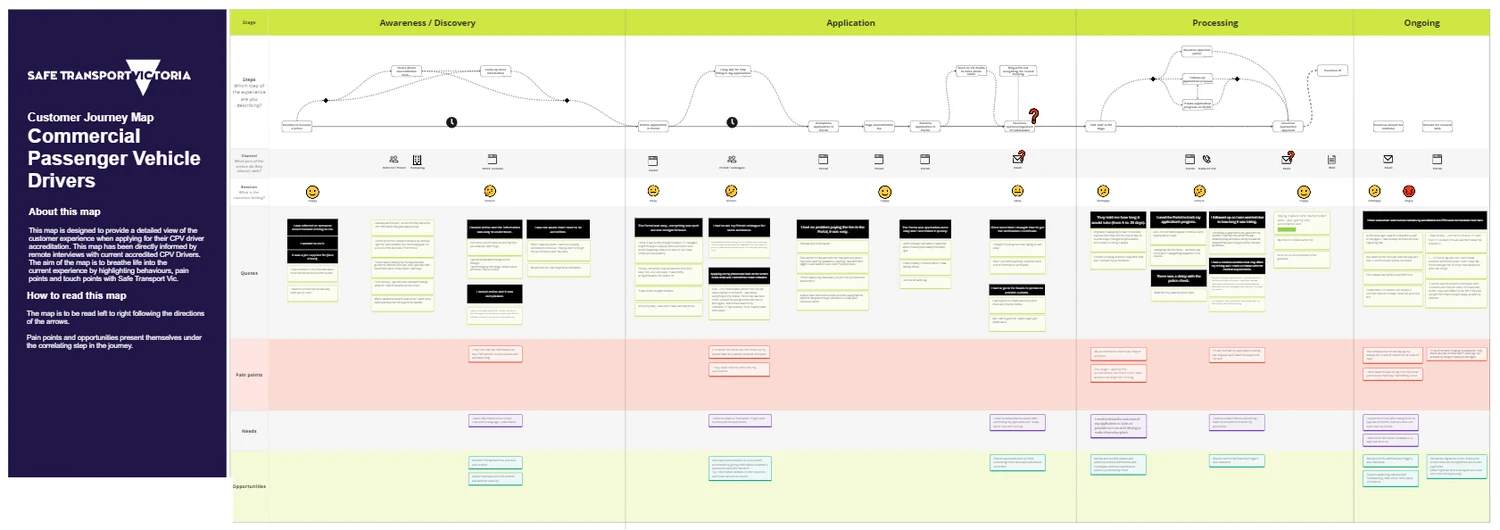
The journey map connects awareness, application, processing and ongoing accreditation to customer behaviours, channels, pain points, needs and opportunities.
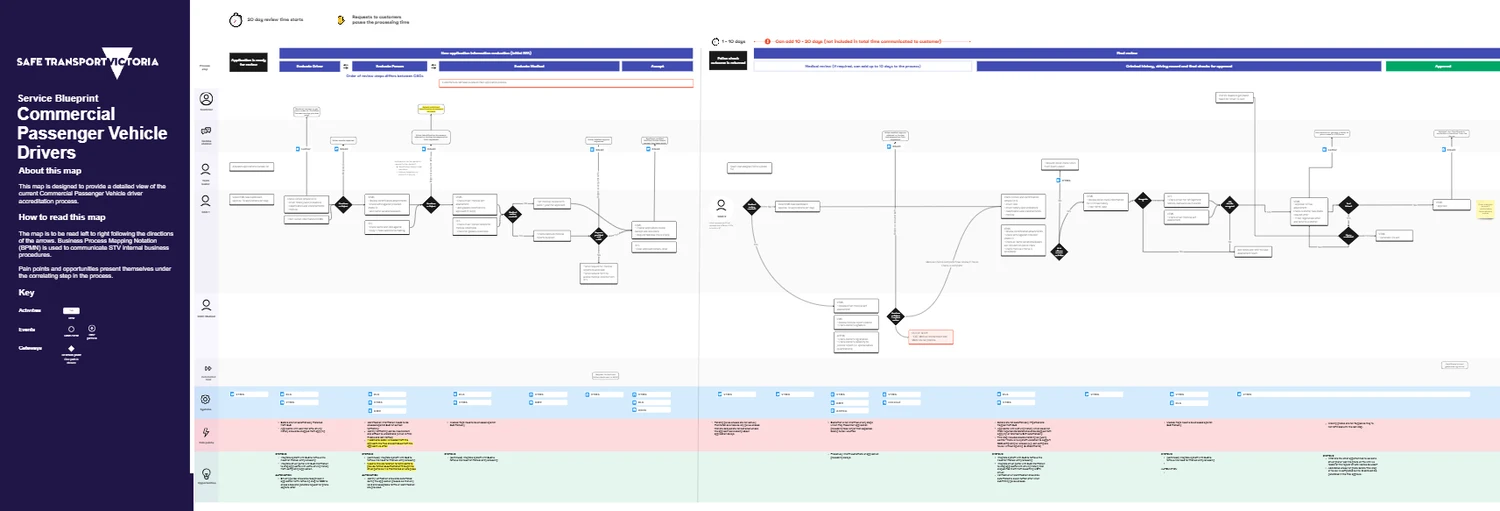
The service blueprint connects customer actions with staff activity, system touchpoints, decision gates and service outcomes across the accreditation lifecycle.
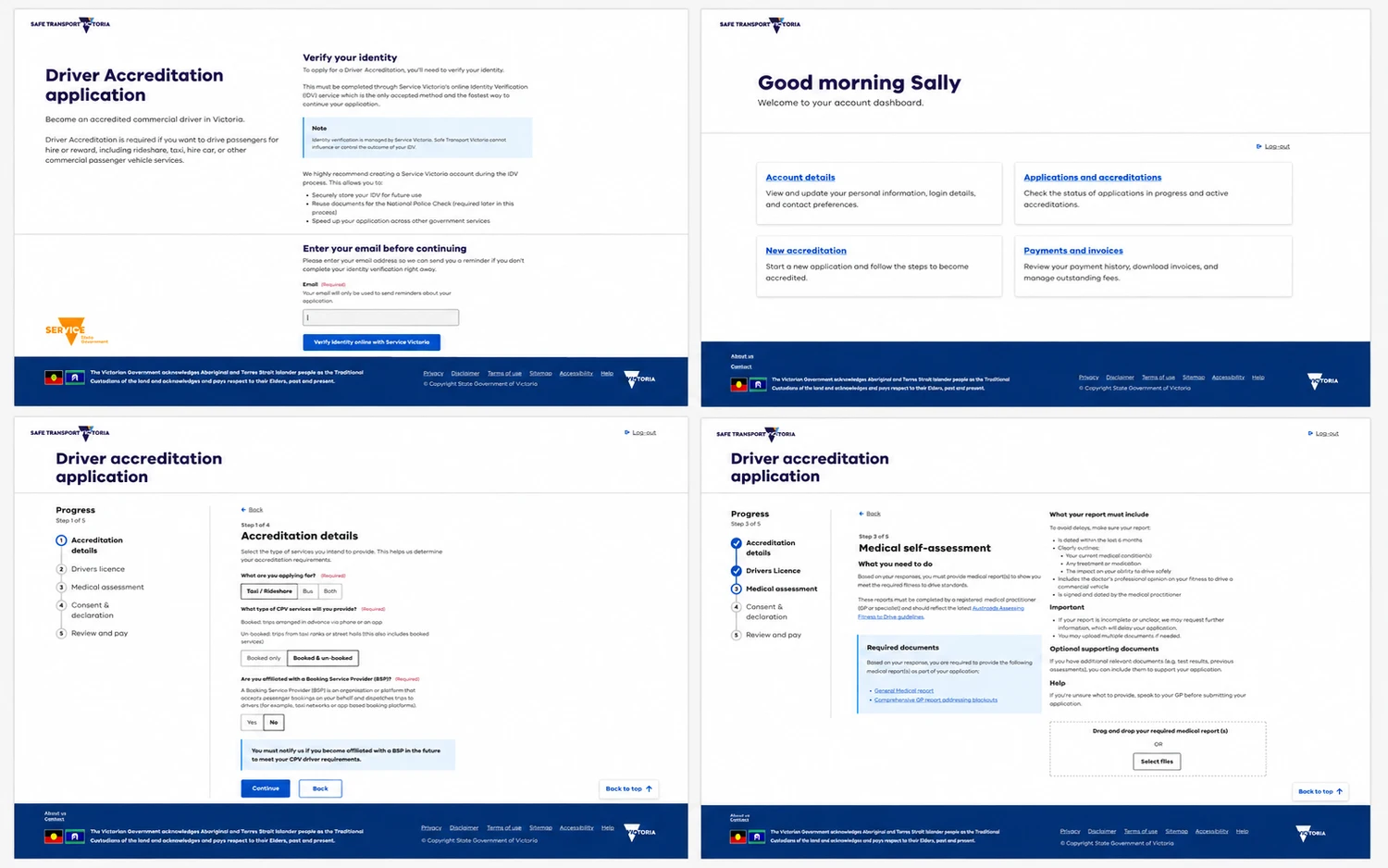
The process view brings the main application, medical, assessment and ongoing-accreditation stages together so reuse and service-specific rules are easier to see.
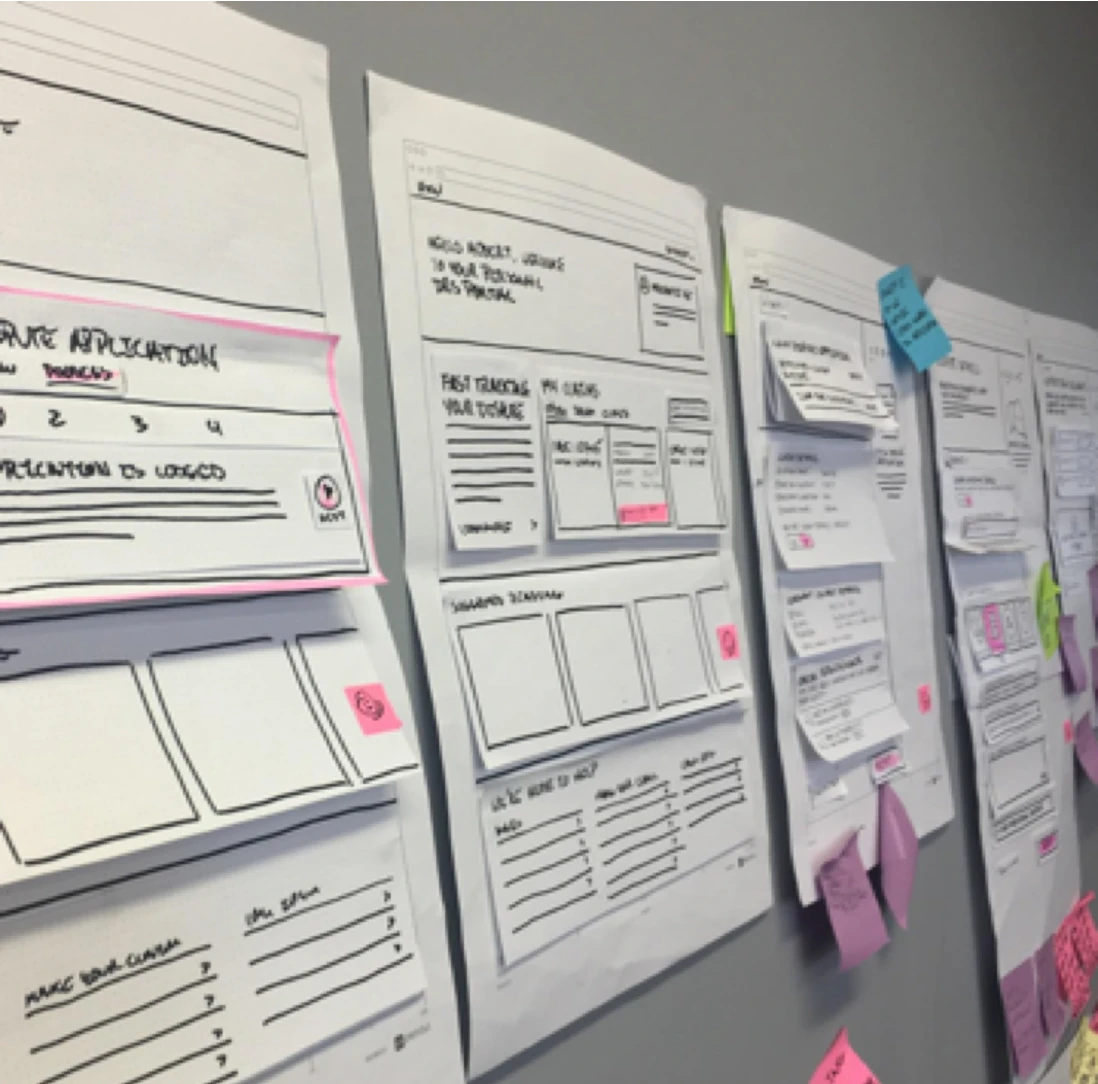
Low-fidelity artefacts helped teams compare service needs, challenge inherited process assumptions and work through what could be reused, adapted or needed to remain specific to Driver Accreditation.
The opportunity
Applying the shared Future Systems accreditation model to Driver Accreditation while preserving service-specific medical, licensing, evidence and renewal rules.
My contribution
I used the first accreditation service as a strategic starting point, then separated what could be reused, adapted or needed to remain unique.
Public portfolio version. Sensitive architecture, security, commercial and operational detail has been intentionally omitted.
Context and challenge
Once Driver Instructor Accreditation had established a target-state pattern, the next challenge was reuse.
Driver Accreditation shared many structural needs, but its licensing, medical, evidence, operator relationships, renewal and ongoing maintenance rules were different. Simply copying the first service would create new friction; designing everything again would lose the value of a common platform.
My role
- Compared the two accreditation journeys and identified common and service-specific needs.
- Facilitated focused requirements and service-design workshops.
- Challenged inherited fields, documents and process steps.
- Mapped medical, licence, profile, application and renewal requirements.
- Defined boundaries between reusable platform capability and policy-specific configuration.
- Carried lessons from the first implementation into the second service.
Strategic and service design response
Reuse the service need, not just the screen
For every candidate pattern we tested whether the underlying service need was genuinely the same: identity, evidence, status, notifications, assessment or customer action.
Use a reuse–adapt–unique model
Reuse where the service need was structurally the same. Adapt where the pattern was useful but rules or content differed. Unique where policy or operations genuinely required a different approach.
Challenge inherited complexity
Workshops separated legislative requirements from operational preference, historical workaround and data collected simply because a legacy process had always asked for it.
Design as part of a service portfolio
The journey considered shared customer profiles, identity, contact data, correspondence, renewals, monitoring and staff visibility rather than treating the application as a standalone transaction.
Outcome and impact
- Faster discovery by starting from an established service pattern.
- Clearer distinction between common capability and regulatory variation.
- Reduced duplication in profile, evidence and case-management design.
- More deliberate decisions about configuration versus customisation.
- A stronger foundation for future services to adopt the same reuse model.
Why it matters
The strategic value of a transformation platform appears when the second and third services become easier to design and deliver than the first. This work focused on creating that compounding value.