
Strategic Design
Future Systems
Designing a unified regulatory service model
A multi-year transformation moving fragmented regulatory services toward a more consistent, reusable and digitally enabled service model.
Selected project evidence
The work behind the outcome.
Research, journeys, prototypes and delivered outputs selected to show how the project moved from evidence to decision and delivery.
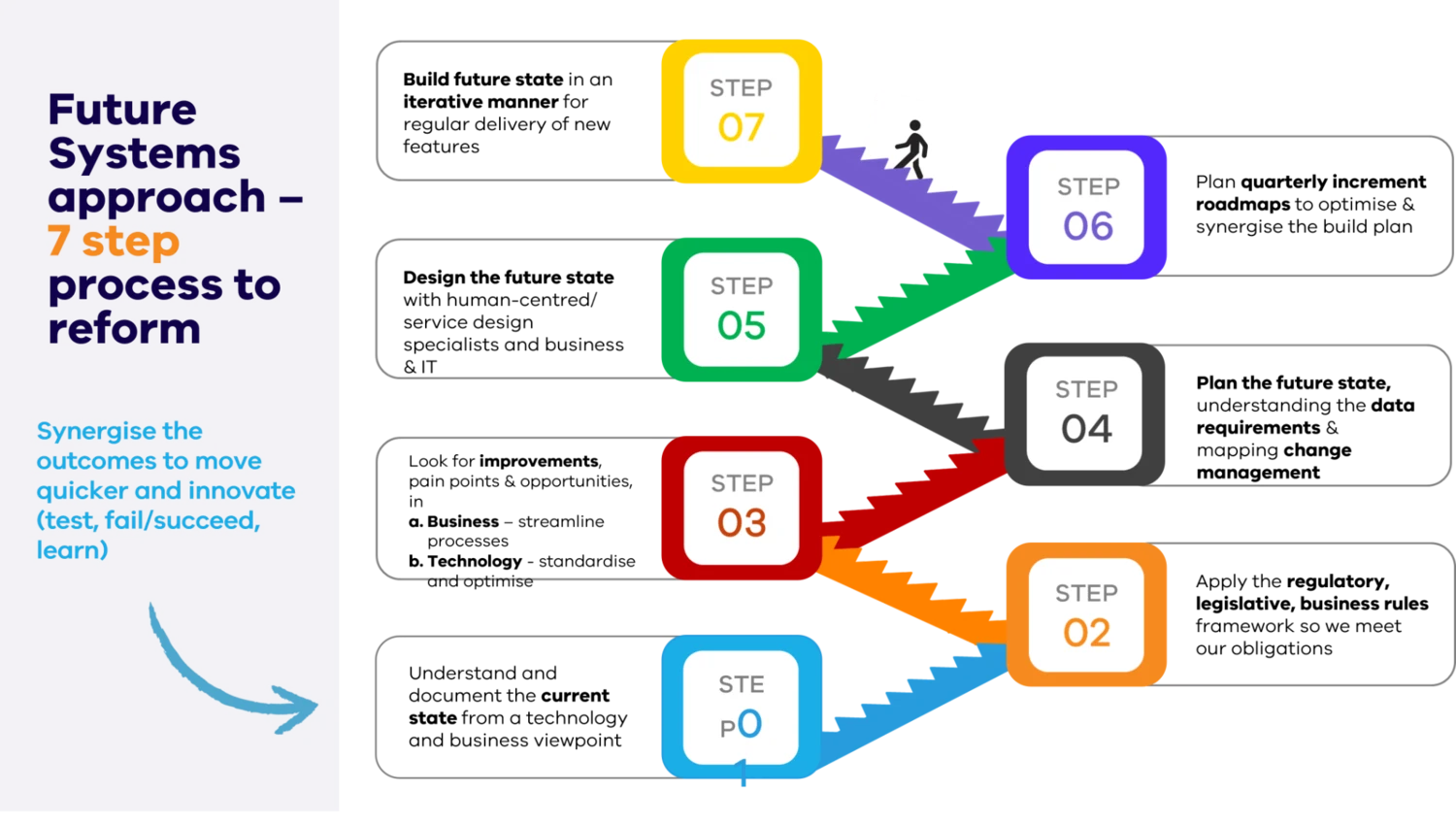
The transformation approach created a repeatable path from framing and evidence through design, prioritisation, delivery and learning.
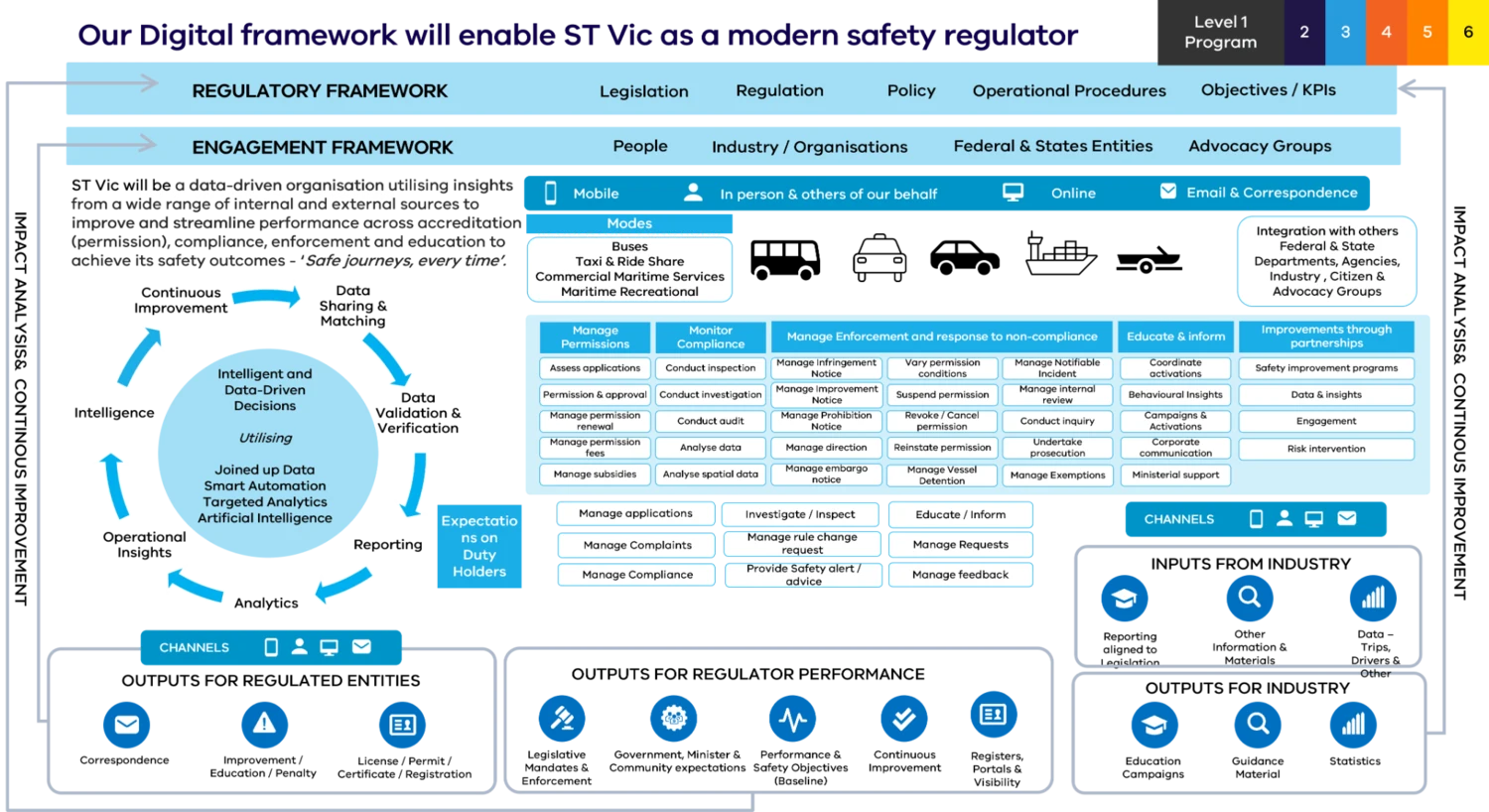
The program framework connected regulatory obligations, engagement, channels, permissions, compliance, enforcement and data into one transformation view.
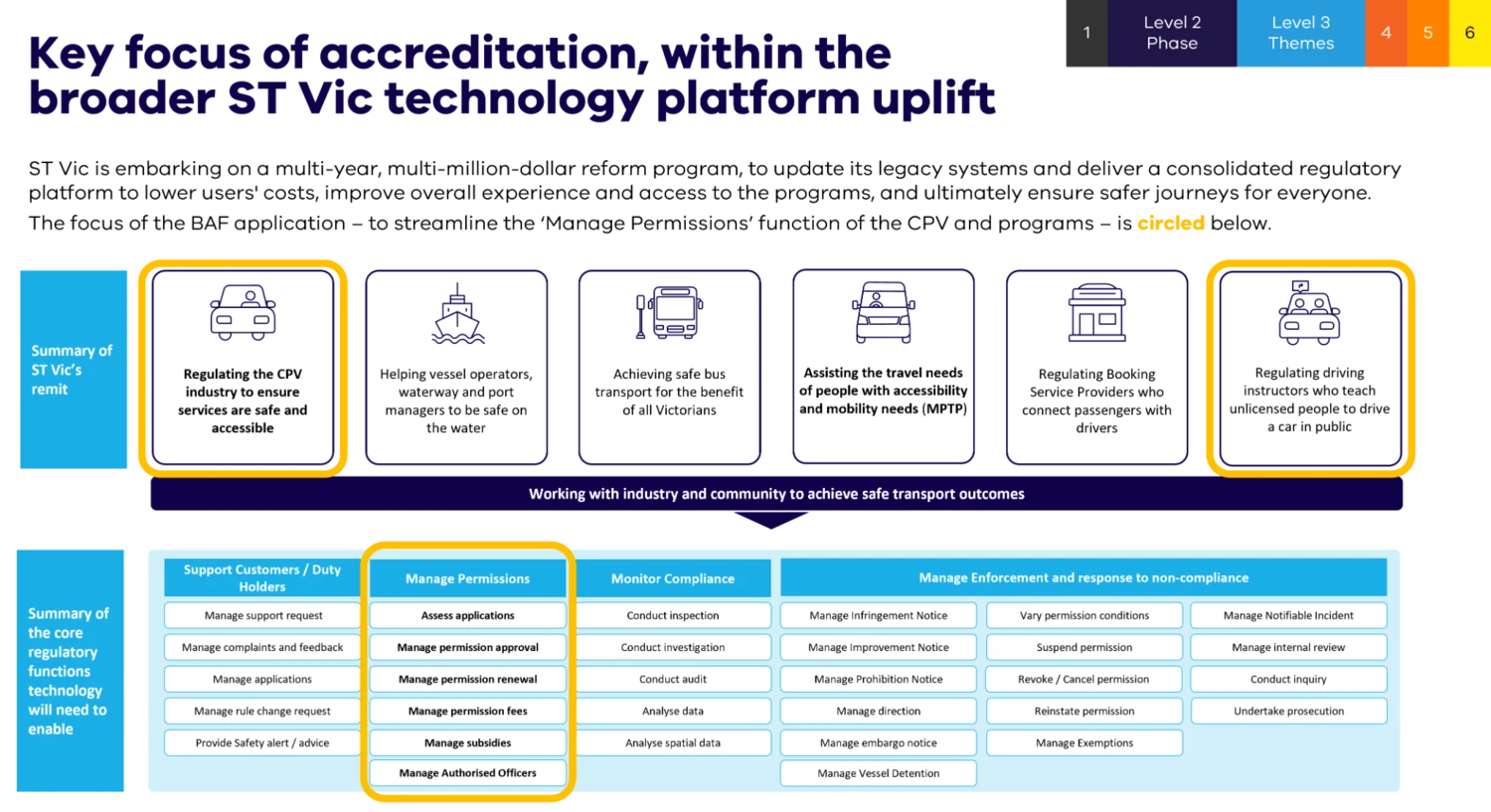
A capability view helped focus the platform uplift on the core regulatory functions and service areas that technology needed to enable.
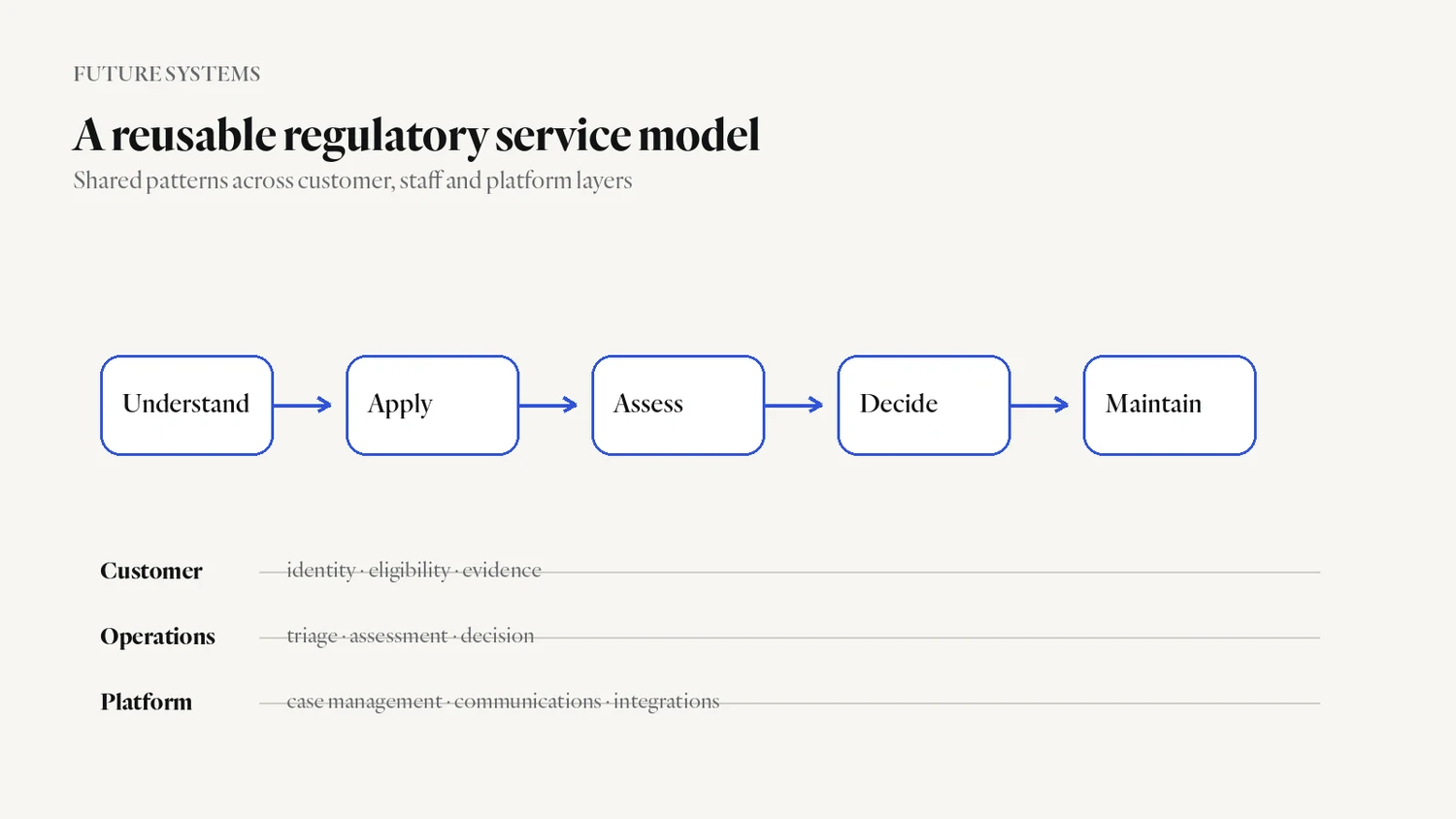
A simplified view connected reusable platform capability with service-specific needs so individual services could move faster without losing regulatory context.
The opportunity
A multi-year transformation moving fragmented regulatory services toward a more consistent, reusable and digitally enabled service model.
My contribution
I reframed the program from system replacement to service transformation, defined reusable service patterns and connected customer journeys with operational, policy and technology change.
Public portfolio version. Sensitive architecture, security, commercial and operational detail has been intentionally omitted.
Context and challenge
Safe Transport Victoria was modernising regulatory services that had evolved across different business areas, channels and legacy systems. Similar customer needs were being handled through different forms, terminology, processes and back-office workarounds.
The strategic risk was clear: a new platform could improve technology while preserving the same service fragmentation.
The design challenge was therefore bigger than creating new digital forms. We needed to define a future service model that could work across accreditation, complaints, incidents, compliance and other regulatory services, while still respecting the policy differences that genuinely mattered.
My role
Working within Design, Architecture & Strategy, I led service design across priority Future Systems initiatives and helped connect strategic direction to detailed delivery.
- Framed transformation around customer and regulatory outcomes rather than system features.
- Mapped current-state customer, staff and operational journeys.
- Defined target-state journeys, service blueprints and reusable patterns.
- Facilitated cross-functional workshops across policy, customer service, operations, architecture and delivery.
- Separated true regulatory requirements from inherited process and legacy-system constraints.
- Translated service design into requirements, decision records, user stories and implementation guidance.
- Worked with external dependencies where services relied on identity, licensing, payments, background checks or other government data.
Strategic and service design response
Reframe the unit of design
Instead of treating each transaction as a separate project, I helped shift the unit of design to a reusable regulatory service system. The key question became: what is the simplest, safest and most consistent future service we can design, and what must change behind the scenes to deliver it?
Establish common principles
We used a shared set of principles to guide decisions: safety and regulatory integrity, customer-centred design, business-led outcomes, data-informed decisions, unified service patterns, configuration before customisation, reuse before bespoke build, and outcomes before outputs.
Design reusable service patterns
Across different services, many needs were structurally similar: identity, eligibility, profile information, evidence, external checks, payment, assessment, requests for more information, decisions, notifications and ongoing monitoring.
These became reusable patterns that could be adapted to the regulatory rules of each service rather than reinvented every time.
Connect front stage and back stage
Customer journeys were explicitly connected to staff tasks, policy rules, data, integrations, case management, correspondence, hand-offs and operational decisions. This made the target state useful to both business and technology teams.
Scale learning from one service to the next
The approach was designed to compound. The first end-to-end service established patterns and decisions that could be tested, adapted and reused across later services, reducing the need to restart discovery from zero.
Outcome and impact
The work established a common design language and a stronger connection between strategy and delivery across the transformation.
- A shared target-state direction across customer, business and technology teams.
- Reusable patterns for common regulatory interactions.
- Clearer distinction between policy requirements and inherited process.
- Better visibility of dependencies across the whole service.
- A scalable design approach that can be reused across future services.
- Reduced risk of recreating legacy fragmentation on the new platform.
Why it matters
The most important outcome was not a single interface. It was a shift from designing isolated transactions to designing a coherent service ecosystem.
That creates the foundation for regulatory services that are more consistent for customers, easier for staff to operate and easier for the organisation to improve over time.