
Strategic Design
VicRoads Website Content Audit
Turning content quality into a service-design input
During the Digital Uplift discovery, I identified website content as a service barrier that needed to be understood systematically rather than treated as a page-by-page copy problem.
Selected project evidence
The work behind the outcome.
Research, journeys, prototypes and delivered outputs selected to show how the project moved from evidence to decision and delivery.
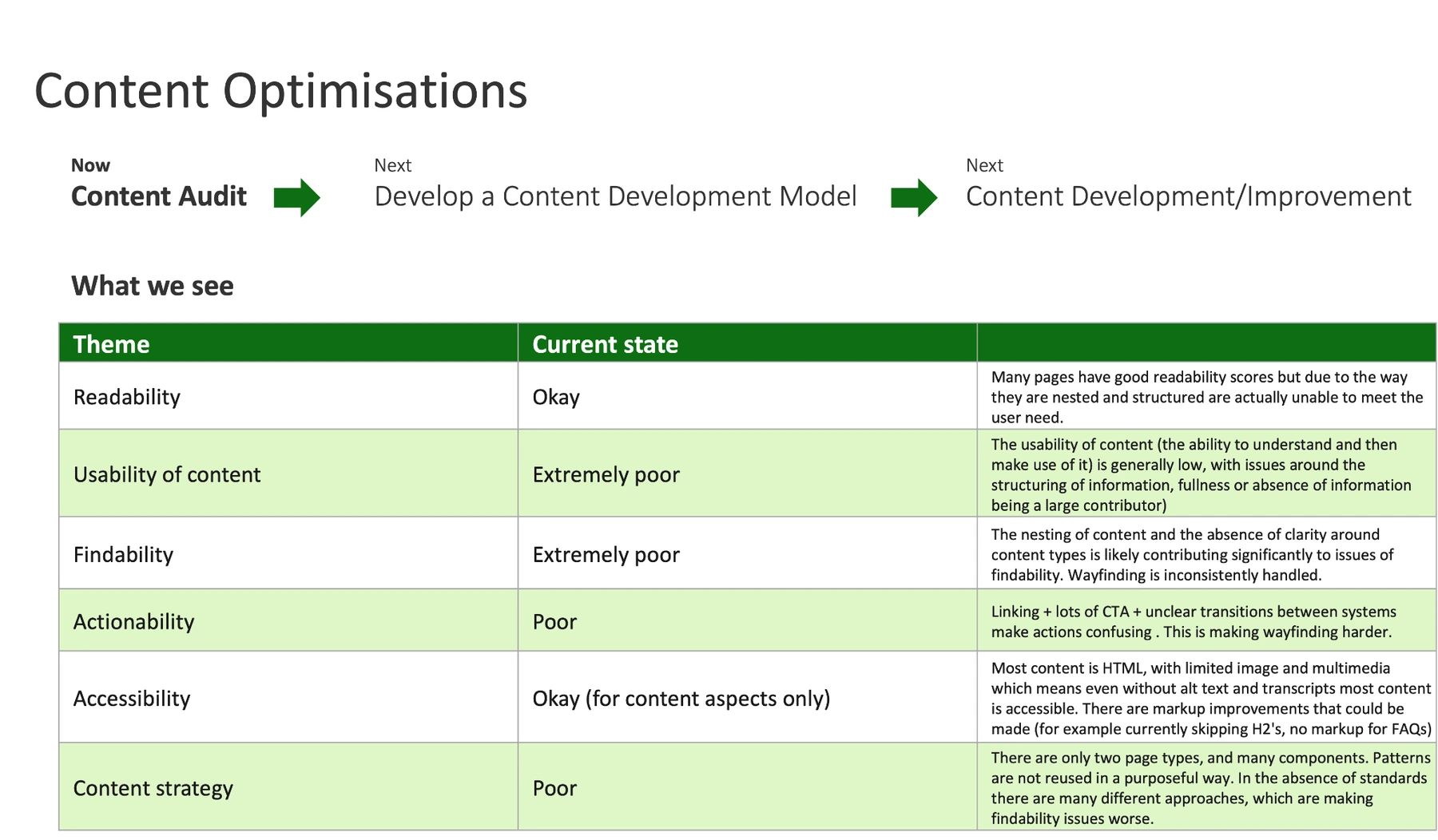
The content work was positioned as the first step in a broader improvement model: understand the current state, establish a repeatable content-development approach, then improve priority content systematically.
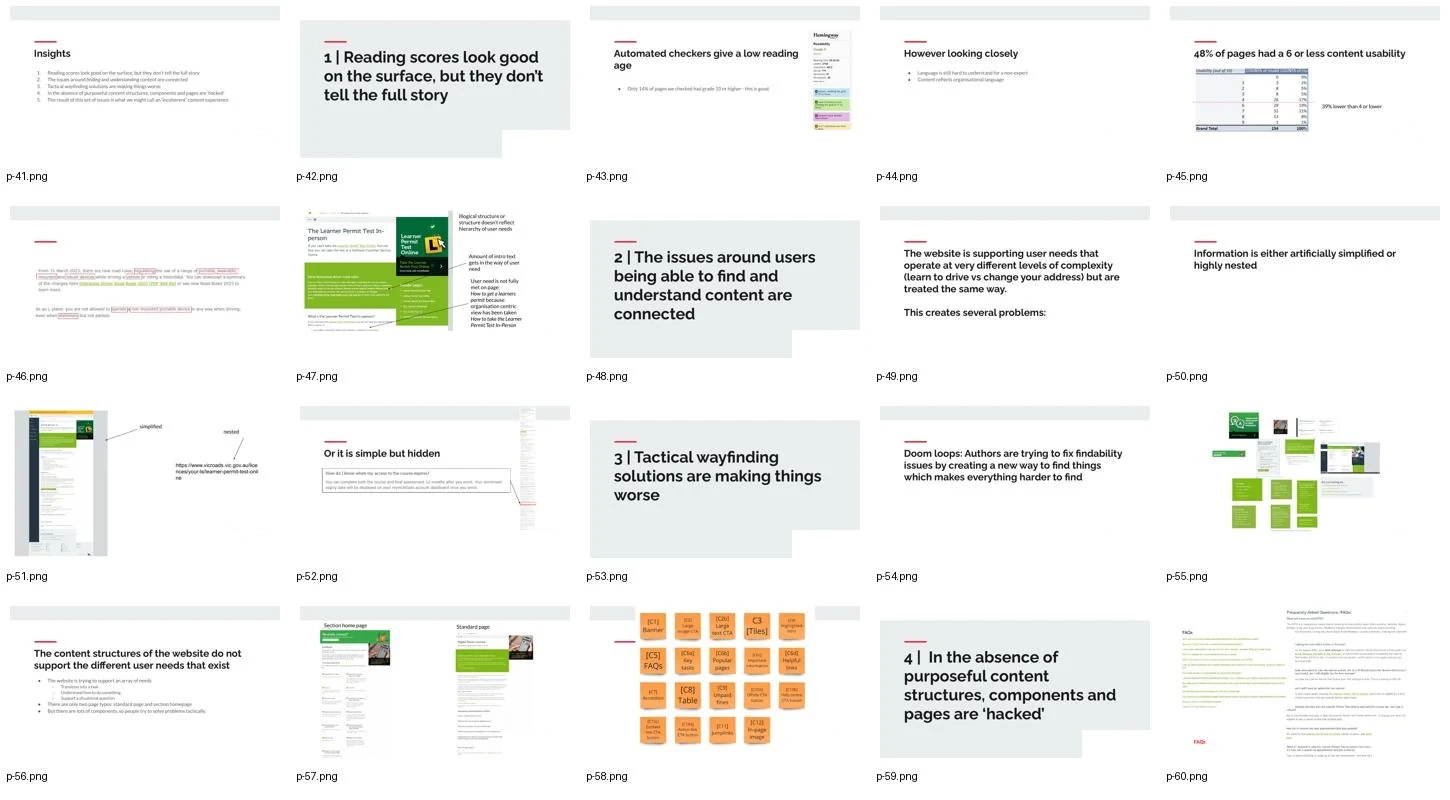
The specialist audit surfaced recurring issues across readability, usability, findability and content structure. I commissioned and liaised with the external content agency, then connected the findings to the broader Digital Uplift work.
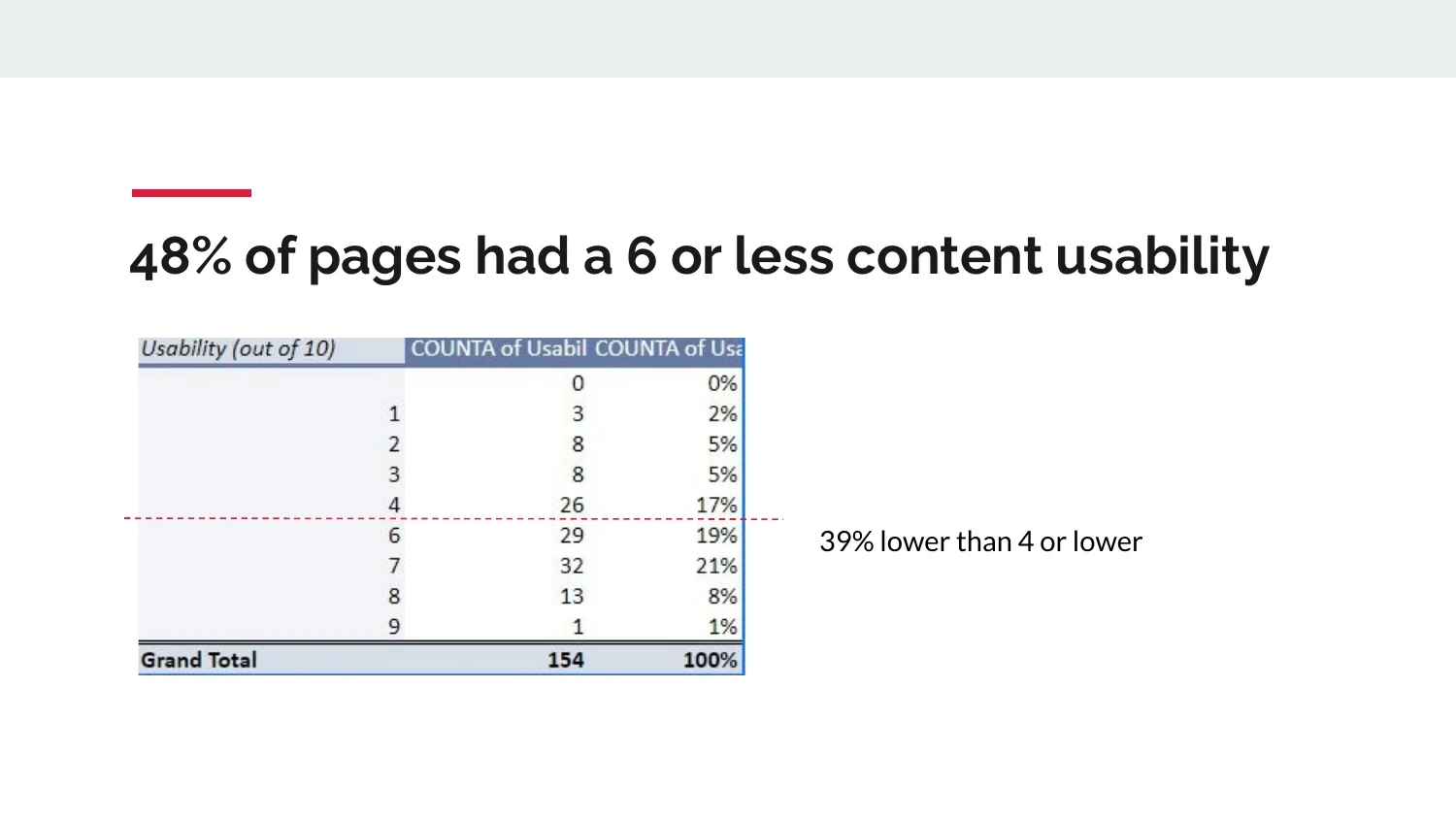
A detailed finding showed that acceptable readability scores could mask much deeper usability problems, helping shift the conversation from page copy to the end-to-end service experience.
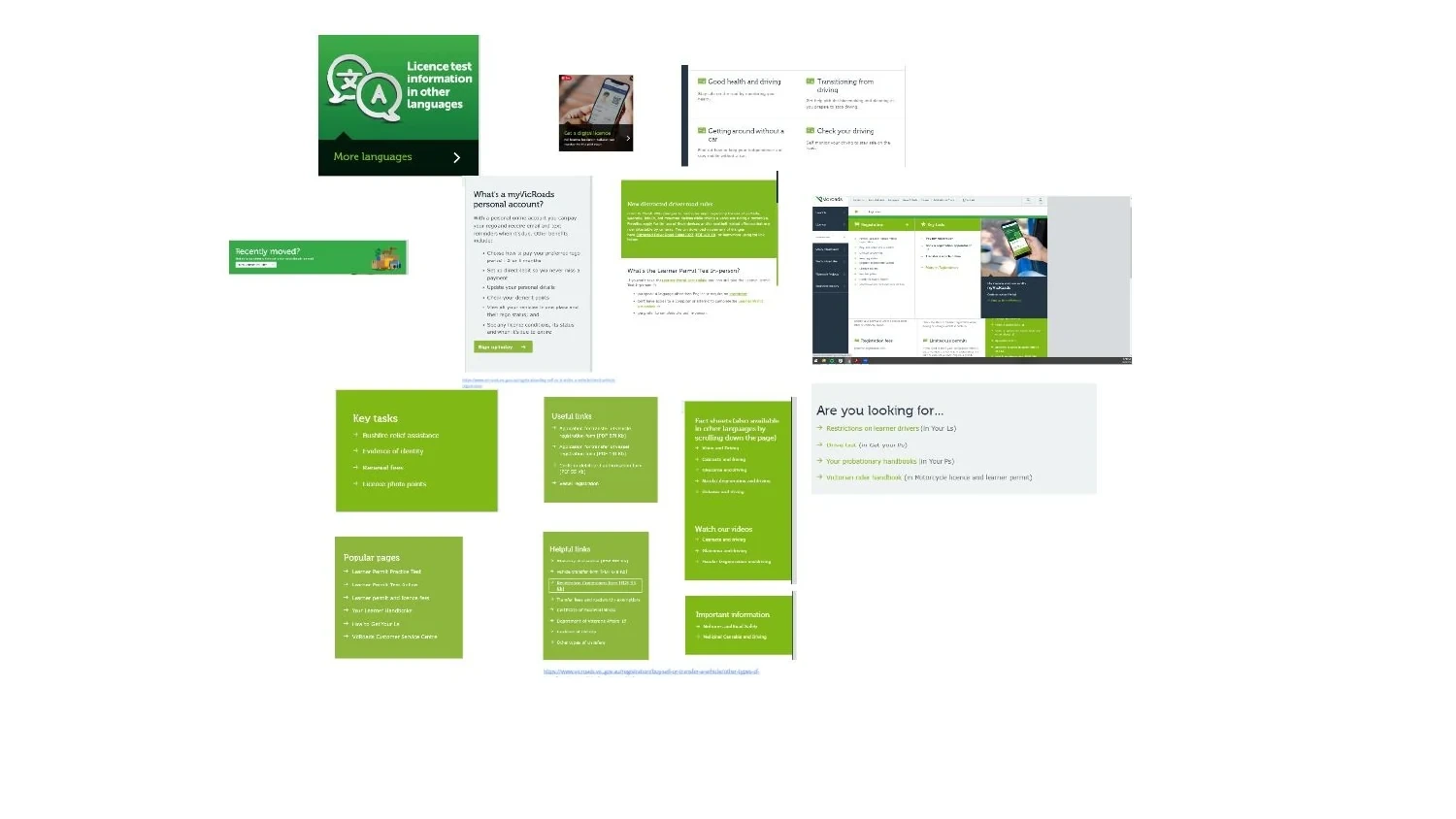
The audit outputs helped frame a more systematic improvement agenda, linking content quality to governance, patterns and future optimisation work.
The opportunity
During the Digital Uplift discovery, I identified website content as a service barrier that needed to be understood systematically rather than treated as a page-by-page copy problem.
My contribution
I identified the need for the audit, engaged and liaised with an external content-strategy agency, connected the scope to priority customer journeys and translated the findings into broader Digital Uplift priorities.
Context and challenge
As part of the VicRoads Digital Uplift discovery, it became clear that many customer problems were not simply interface problems. Customers also had to find, interpret and act on a large body of website content that had grown over time across different service areas.
The attached audit material highlights the underlying content problem: complex information increases cognitive load, while inconsistent structures, buried information and tactical wayfinding fixes can make already difficult journeys harder to navigate.
My role
I identified the need for a dedicated content audit and engaged an external content-strategy agency to provide specialist depth. I did not present the agency’s audit work as my own. My role was to initiate the work, connect it to the transformation context, liaise with the agency and stakeholders, and make sure the findings informed the broader service-design and Digital Uplift agenda.
- Framed the need for content to be treated as part of the customer experience, not as a separate publishing concern.
- Connected the audit scope to priority journeys being explored through Digital Uplift discovery.
- Liaised with the external agency and internal stakeholders during the work.
- Used the findings to challenge page-by-page fixes and support a more systemic view of findability, structure and content governance.
- Translated content findings into service-design priorities and future-state recommendations.
What the audit added
Evidence beyond readability scores
The work showed that automated reading scores could look acceptable while the underlying experience was still difficult. Customers could face dense language, unclear hierarchy and content that was technically present but hard to find or interpret.
Findability and comprehension are connected
The audit made visible how users being able to find and understand information are part of the same service problem. Content hidden in deep structures, inconsistent page patterns and tactical links could create dead ends instead of supporting a clear journey.
Different customer needs need different structures
The source material showed that VicRoads supported very different levels of task complexity. Treating all of those needs with the same generic content structure contributed to inconsistency and made some journeys unnecessarily difficult.
Outcome and impact
The value of the audit was not a stand-alone content report. It gave the Digital Uplift program stronger evidence for where content, information architecture and service design needed to work together.
- Content quality became a visible transformation issue rather than a downstream editing task.
- Findability, comprehension and page structure were incorporated into service-design discussions.
- The audit provided specialist evidence that could be combined with analytics, journey discovery and customer research.
- It supported a shift from isolated page fixes toward clearer, more consistent and more maintainable content patterns.
Why it matters
For high-volume government services, content is part of the service. If customers cannot find or understand what they need, the organisation creates avoidable effort, assisted-channel demand and loss of confidence even when the underlying transaction works.